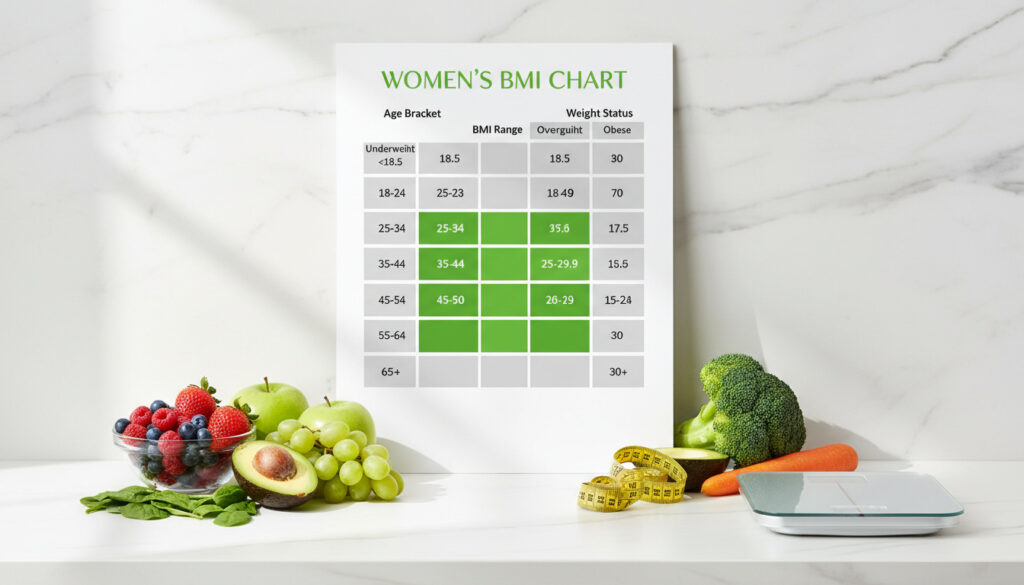
Healthy BMI for Women – Ranges, Charts and Age Guide
Body Mass Index serves as the standard metric for assessing weight status in adult women, with health authorities establishing 18.5–24.9 as the healthy range for those aged 20 and older. This classification system applies universally regardless of sex, though physiological differences mean individual interpretations require nuanced consideration.
Medical institutions including the Centers for Disease Control and Prevention and World Health Organization utilize these categories for population health screening. While the calculation remains straightforward, applying the results to individual health assessments demands understanding of inherent limitations.
Women should understand these metrics within the context of specific ranges, calculation methods, age-related variations, and accuracy constraints.
What Is a Healthy BMI Range for Women?
- The 18.5–24.9 range applies universally to adult men and women regardless of age between 20 and 50.
- Health authorities including the CDC and WHO maintain identical category thresholds for both sexes.
- Postmenopausal women may carry excess adiposity despite falling within the healthy range.
- The metric functions primarily as a population screening tool rather than individual diagnostic measure.
- Athletes with significant muscle mass often register misleading classifications.
- No official adjustment exists for frame size or body composition variations.
| Classification | BMI Range | Health Risk Level |
|---|---|---|
| Underweight | <18.5 | Increased |
| Healthy weight | 18.5–24.9 | Normal |
| Overweight | 25.0–29.9 | Increased |
| Obesity Class I | 30.0–34.9 | High |
| Obesity Class II | 35.0–39.9 | Very High |
| Obesity Class III | ≥40.0 | Extremely High |
BMI Chart for Women by Height and Age
Height-specific weight charts provide concrete reference points for women determining their classification without calculation. Medical News Today publishes standardized tables correlating stature with healthy weight ranges.
Understanding Height-to-Weight Correlations
For a woman standing 5 feet 4 inches, the healthy weight range spans approximately 110 to 140 pounds. At 5 feet 8 inches, this shifts to 125–158 pounds. These figures assume average muscle mass and bone density.
Age-Related Distribution Patterns
While the mathematical categories remain static across age groups, Healthline notes that women over 50 often experience sarcopenia—age-related muscle loss—that can distort BMI accuracy.
Standard charts assume standard body composition. Women with athletic builds or those over 74 may need adjusted interpretations.
How to Calculate BMI for Women
The calculation requires only two measurements: weight in kilograms divided by height in meters squared. For imperial units, multiply weight in pounds by 703, then divide by height in inches squared.
Manual Calculation Method
A woman weighing 150 pounds at 5 feet 6 inches tall would calculate: (150 × 703) ÷ (66 × 66) = 24.2, placing her within the healthy range.
Digital Calculator Tools
The CDC’s online calculator automates this mathematics, instantly displaying both the numeric result and corresponding category. Similar tools are available through the American Cancer Society.
While calculating metrics can seem complex, understanding measurements is essential for health management, much like knowing conversions when referencing UK to EU Shoe Size – Charts for Men, Women & Kids for proper footwear fitting.
Healthy BMI for Women by Age
Official CDC and WHO standards maintain the 18.5–24.9 threshold for all adults over 20, yet physiological changes suggest interpretive flexibility for older populations.
Considerations for Women Over 50
Better Health Victoria suggests that for Australians over 74, a range of 22–26 may prove acceptable, prioritizing nutritional reserves over mild overweight concerns. No official CDC or NHS age-adjusted charts currently exist for women over 50.
Postmenopausal Body Composition
Estrogen decline triggers visceral fat redistribution to the midsection, which BMI fails to capture. Postmenopausal women may exhibit healthy range BMI while carrying dangerous levels of internal adipose tissue.
Muscle loss after 50 averages 1–2% annually, potentially lowering BMI despite increased body fat percentage.
BMI should never serve as the sole diagnostic tool for women over 50; waist circumference and body composition analysis provide necessary complementary data.
BMI Limitations for Women
While BMI provides useful population data, individual assessments require acknowledging significant blind spots in the formula.
Muscle Mass and Athletic Builds
The index cannot differentiate between adipose tissue and lean muscle. Female athletes routinely register as overweight or obese despite possessing optimal body composition and cardiovascular health.
Ethnic and Body Shape Variations
Research indicates that women of Hispanic ethnicity may carry higher body fat percentages at identical BMI readings compared to other populations. NIH tables confirm distribution patterns vary significantly across demographics.
Pregnancy and Hormonal Factors
Pregnancy renders BMI calculations meaningless for gestational weight tracking. Additionally, menopause-related hormonal shifts redistribute fat to the abdominal region without changing overall mass, masking metabolic risk.
How Has BMI Measurement Evolved?
The metric’s history reveals shifting medical understanding of weight and health.
- : Belgian mathematician Adolphe Quetelet develops the Quetelet Index, establishing the mathematical relationship between height and weight.
- : Physiologist Ancel Keys renames the formula “Body Mass Index,” popularizing its use in population studies.
- : The World Health Organization adopts standardized BMI categories for international obesity surveillance.
- : Contemporary health resources continue refining application guidelines while maintaining the original calculation.
What Is Certain and Uncertain About BMI Accuracy?
Scientific consensus exists regarding specific applications, while individual assessment remains contested.
| Established Facts | Remaining Uncertainties |
|---|---|
| Reliable for population-level body fat screening in non-muscular adults | Individual muscle-to-fat ratio accuracy |
| Universal calculation formula: kg/m² | Ethnic-specific thresholds for metabolic risk |
| Consistent category thresholds across sexes | Optimal ranges for pregnant women |
| Strong correlation with mortality risk at population level | Precision for individual health prediction |
Why Does BMI Matter for Women’s Health?
Health institutions utilize these classifications to track population trends and identify risk factors for metabolic syndrome, cardiovascular disease, and diabetes. For individual women, the metric offers an accessible starting point for health discussions with medical providers.
However, the simplicity that makes BMI attractive also limits its utility. Much like quick remedies such as How to Get Rid of Hiccups – Effective Remedies Guide provide immediate solutions for minor issues, BMI offers immediate classification, but complex health conditions require deeper analysis.
Excessive focus on BMI alone may overlook critical factors including bone density, hydration status, and hormonal influences specific to female physiology.
What Do Health Authorities Say About BMI?
BMI provides a reliable indicator of body fatness for most people and is used as a screening tool to identify possible weight problems.
Centers for Disease Control and Prevention
The classification system remains unchanged for adults over 20, though interpretation should consider individual factors.
World Health Organization Standards
Key Takeaways on Healthy BMI for Women
The healthy BMI range of 18.5–24.9 provides a useful screening framework for adult women, though individual assessment requires consideration of age, muscle mass, and body composition. Women over 50 should interpret results cautiously, potentially supplementalizing with waist measurements.
Frequently Asked Questions
Is 25 BMI overweight for a woman?
Yes, a BMI of 25.0 falls into the overweight category according to CDC and WHO standards. The healthy range tops out at 24.9.
Does BMI account for muscle mass in women?
No, BMI cannot distinguish between muscle and fat. Athletic women with significant muscle mass may register as overweight despite having low body fat.
What is a healthy BMI for a 5’5″ woman?
A 5’5″ woman typically maintains a healthy BMI between 111 and 149 pounds, corresponding to the 18.5–24.9 range.
Is BMI accurate for petite women?
BMI accuracy diminishes for women under 5 feet or with small frames, as the formula assumes average bone density and organ mass.
Should women use a different BMI calculator than men?
No, the calculation formula remains identical. However, women should interpret results within the context of hormonal cycles, pregnancy status, and menopause.
More related posts
 Gaia Wise – Biography Career and Personal Life
 BBC Weather Tunbridge Well – Today, Tomorrow & 14-Day Foreca t
 Cargo Pants for Women – Top Styles and UK Buying Guide
 Cast of Oppenheimer (Film) – Full Cast and Crew Guide
 Cast of the Notebook – Complete Guide to Actors and Roles
 Ye Olde Bell Spa – Guide to Offers, Prices and Reviews
 Police Service of Northern Ireland – Contact, Careers & More
 How Many Units Can You Drive On – UK Limits & Scotland Guide