How Many Liters in a Gallon – US vs UK Conversion Chart
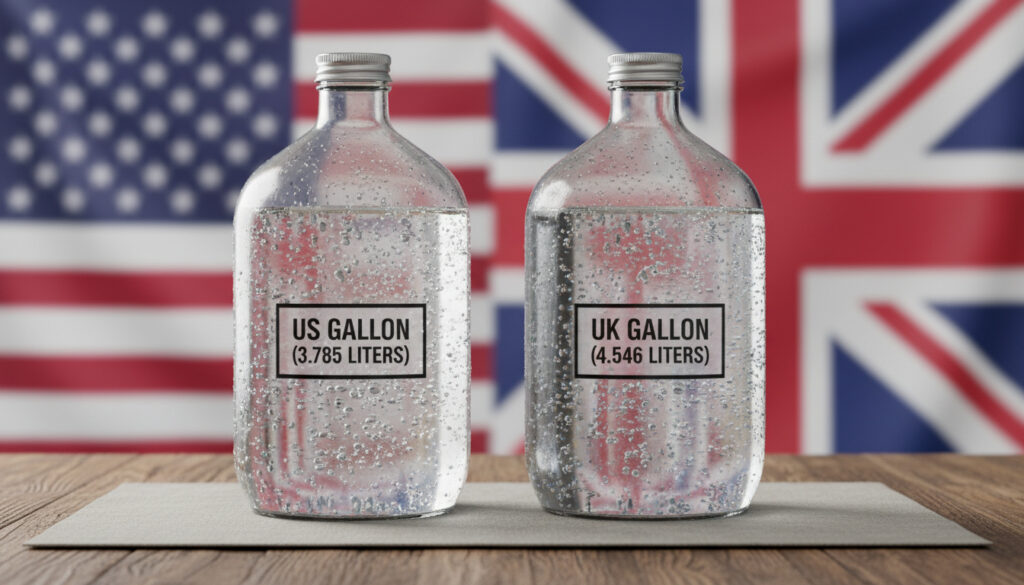
Converting gallons to liters requires precision, yet the answer depends entirely on which gallon standard applies. The United States and the United Kingdom maintain distinct definitions that differ by approximately twenty percent, a discrepancy that affects fuel calculations, recipe conversions, and international shipping volumes.
The US liquid gallon, rooted in the 18th-century Winchester wine gallon, contains exactly 3.785411784 liters according to the National Institute of Standards and Technology (NIST). Conversely, the UK imperial gallon, established by the 1824 Weights and Measures Act, holds exactly 4.54609 liters. These fixed values provide the foundation for all modern conversion calculations.
Understanding which standard applies in a given context prevents costly errors. Fuel economy figures, beverage packaging, and industrial specifications all reference one or the other, though the US gallon dominates North American commerce while the imperial gallon persists in select Commonwealth nations despite widespread metrication.
How Many Liters Are in a Gallon?
- NIST defines the US gallon as exactly 3.785411784 liters, a value derived from 231 cubic inches.
- The imperial gallon equals exactly 4.54609 liters, fixed by UK legislation in 1985.
- One imperial gallon is approximately 20.095% larger than one US gallon.
- Reciprocal conversions yield 1 liter ≈ 0.264172 US gallons or 0.219969 imperial gallons.
- Fuel economy ratings require careful distinction; 30 mpg (US) differs significantly from 30 mpg (imperial).
- Dairy and beverage packaging historically used distinct jug sizes based on regional gallon standards.
| Gallons | US Gallons to Liters | Imperial Gallons to Liters |
|---|---|---|
| 1 | 3.785411784 | 4.54609 |
| 2 | 7.570823568 | 9.09218 |
| 3 | 11.356235352 | 13.63827 |
| 4 | 15.141647136 | 18.18436 |
| 5 | 18.92705892 | 22.73045 |
| 10 | 37.85411784 | 45.4609 |
US vs. UK Gallon: Key Differences in Liters
The divergence between American and British gallon standards traces back to separate historical acts of legislation. The United States inherited the Winchester wine gallon of 231 cubic inches, standardized in the early 19th century, while the British Empire redefined its measure in 1824 based on the weight of water.
Defining the US Liquid Gallon
The US liquid gallon derives from the 1707 Winchester wine gallon, defined as 231 cubic inches exactly. NIST codifies this as 3.785411784 liters, maintaining compatibility with 18th-century trade measurements. This standard governs fuel sales, milk packaging, and water distribution throughout the United States. System comparisons illustrate how this colonial-era standard persisted post-independence.
Understanding the Imperial Gallon
The imperial gallon originated with the 1824 British Weights and Measures Act, initially defined as the volume of ten pounds of distilled water at 62 degrees Fahrenheit. Modern standards fixed this at exactly 4.54609 liters in 1985. Visual analysis confirms the imperial gallon remains approximately 20% larger than its US counterpart.
When converting between systems, remember that five imperial gallons equal roughly six US gallons (precisely 6.0045). This 20% discrepancy compounds quickly in bulk shipping and fuel calculations.
How Many Gallons in a Liter and Vice Versa?
Reverse conversions prove essential for international recipes, automotive specifications, and laboratory measurements. The mathematics involves simple division using the standard factors, though precision matters when scaling to larger volumes.
Converting Liters Back to Gallons
One liter equals approximately 0.264172 US gallons or 0.219969 imperial gallons. These reciprocals, derived from the exact NIST factors, enable two-way calculations. Culinary and industrial applications frequently require these inverse conversions when interpreting foreign specifications.
Practical Math for Daily Use
Mental estimation often employs rounded figures: 3.8 liters per US gallon and 4.55 liters per imperial gallon suffice for rough estimates. However, regulatory compliance and scientific work demand the full precision of 3.785411784 and 4.54609 respectively.
Gallons to Liters Conversion for Common Volumes
Specific industries maintain rigid conventions regarding which gallon standard applies. Misapplication in these contexts creates significant measurement errors, particularly in automotive fuel systems and food service packaging. Just as UK to EU Shoe Size – Charts for Men, Women & Kids requires careful conversion between regional standards, gallon conversions demand similar attention to definition.
Fuel and Automotive Applications
A standard five-gallon US gas can holds precisely 18.92705892 liters, though practical labeling often rounds to 18.9 L. UK fuel pumps dispense by the liter, but vehicle specifications may still reference imperial gallons, affecting MPG calculations. Thirty miles per imperial gallon equals only 25 miles per US gallon due to the larger imperial volume.
Ten US gallons of gasoline equals 37.85 liters, while ten imperial gallons equals 45.46 liters. When calculating fuel economy or tank capacity, verify which standard the manufacturer referenced.
Food and Beverage Packaging
Milk packaging illustrates the divergence clearly. A US one-gallon jug contains 3.785 liters, while the former Canadian imperial gallon jug held 4.546 liters. British Columbia’s curriculum materials document this transition as Canada metricated, though older recipes may still specify imperial volumes.
Industrial and Shipping Volumes
The standard oil barrel of 42 US gallons translates to 158.987 liters. In imperial terms, this same volume equals approximately 34.97 imperial gallons. NIST technical documentation provides these exact conversion factors for customs and trade documentation.
International shipping contracts must specify “US gallon” or “imperial gallon” explicitly. Assumption of the wrong standard in bulk liquid transport can result in inventory discrepancies exceeding 20%.
How Did Gallon Measurements Evolve?
- – The Winchester wine gallon (231 cubic inches) becomes the de facto standard in England, later adopted by the American colonies.
- – The British Weights and Measures Act establishes the imperial gallon, defined as the volume of 10 pounds of water at 62°F (approximately 4.54609 liters).
- – The United States formally adopts the wine gallon as the US standard, diverging from the new imperial system.
- – UK legislation fixes the imperial gallon at exactly 4.54609 liters, eliminating the temperature-dependent water weight definition.
What Is Definitively Established vs. What Remains Variable
| Established Facts | Uncertain or Variable Elements |
|---|---|
| US gallon equals exactly 3.785411784 liters (NIST) | Colloquial rounding practices (3.8 L vs precise conversion) |
| Imperial gallon equals exactly 4.54609 liters (BIPM-aligned) | Residual imperial gallon use in Canada post-metrication |
| Imperial gallon is exactly 20.095% larger than US gallon | Automotive MPG rating conventions by region |
| 1824 British Weights and Measures Act created imperial standard | Industry-specific exceptions to standard definitions |
Why Do Two Different Gallon Standards Exist?
The coexistence of US and imperial gallons reflects divergent paths of standardization following American independence. While the British Empire reformed its measures in 1824 to create consistency across trade and taxation, the United States retained the older Winchester standard to maintain continuity with existing infrastructure and commercial practice.
This divergence persists because both standards are deeply embedded in manufacturing, law, and daily commerce. The United Kingdom maintains unique standards across many domains, from volume measurements to sizing conventions, reflecting a broader pattern of retained customary units alongside metric adoption.
International trade agreements and scientific protocols increasingly favor the liter and cubic meter, yet the gallon remains legally sanctioned in both nations for specific applications. Fuel pricing, beverage sales, and certain industrial specifications continue to reference gallons, requiring dual fluency in both systems for cross-border commerce.
What Authorities Define These Conversions?
One US gallon equals 3.785411784 liters (exactly). One imperial gallon equals 4.54609 liters (exactly).
NIST Special Publication 811, Appendix B
The imperial gallon was originally based on the volume of 10 pounds of water at 62°F, but is now defined as exactly 4.54609 litres.
BIPM-Aligned Standards via Wikipedia
Quick Reference: Gallon to Liter Conversions
Precise conversion requires distinguishing between the US liquid gallon at 3.785411784 liters and the imperial gallon at 4.54609 liters. The imperial measure exceeds the US measure by exactly 20.095%, a critical difference for fuel calculations, recipe scaling, and industrial specifications. For additional contexts regarding British standards and historical measurement evolution, see How Many King Williams Have There Been – 4 English Monarchs Explained.
Frequently Asked Questions
Is a gallon bigger than a liter?
Yes, both US and imperial gallons exceed one liter. A US gallon equals 3.785 liters, while an imperial gallon equals 4.546 liters.
How many liters are in a gallon of water?
A US gallon of water contains 3.785411784 liters at standard conditions. An imperial gallon contains 4.54609 liters.
Why are there two different gallon measurements?
The US retained the 1707 Winchester wine gallon (231 cubic inches), while the UK redefined its measure in 1824 as the volume of 10 pounds of water, creating the larger imperial standard.
How many liters are in 5 gallons?
Five US gallons equal 18.927 liters (18.93 rounded). Five imperial gallons equal 22.73045 liters.
Is 3.8 liters close enough for a US gallon conversion?
For rough estimates, 3.8 liters suffices, but it introduces a 0.4% error. Precision work requires 3.785411784 liters.
Which countries still use the imperial gallon?
The UK officially metricated, but the imperial gallon persists in some Commonwealth nations and specific applications, though liters dominate retail fuel sales.
How do you convert liters back to gallons?
Divide liters by 3.785411784 for US gallons, or by 4.54609 for imperial gallons. One liter equals 0.264172 US gallons.
More related posts
 Wayne Couzens – Angiolini Inquiry Reveals Systemic Police Failures
 Road Tax Calculator by Reg – Official UK DVLA Guide and Rates
 Shrek 5 Release Date 2027 – Delays Cast and What We Know
 Ye Olde Bell Spa – Guide to Offers, Prices and Reviews
 Martin Lewis Power of Attorney – More Important Than a Will
 Oakley Motorcycles Kent Closure – Shut Just Before Christmas
 How Old Is Ronnie Wood – Age, Wife, Kids & Net Worth 2025
 Halloween Crafts for Kids – Easy Printable Ideas for 2025