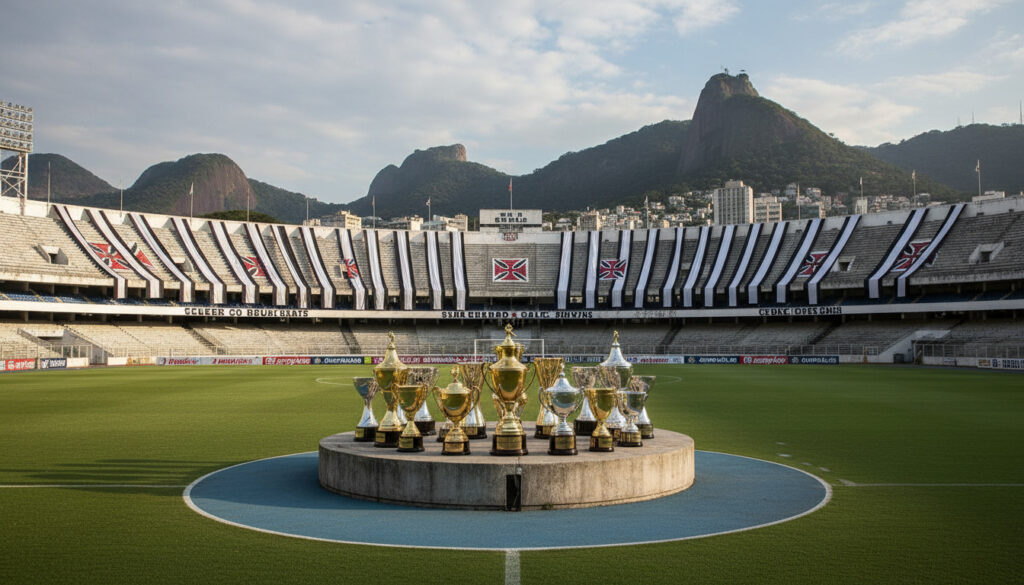
Vasco da Gama FC – History, Achievements and Rivalries
Club de Regatas Vasco da Gama stands as one of Brazil’s most storied sporting institutions, representing more than a century of football tradition intertwined with profound social significance. Founded by Portuguese immigrants in Rio de Janeiro, the organization commonly known as Vasco da Gama FC emerged from rowing origins to become a symbol of resistance against racial and class discrimination in Brazilian sports.
Today, Vasco competes in the Campeonato Brasileiro Série A, maintaining its historical rivalry with Flamengo while playing home matches at the iconic São Januário Stadium. The club’s black-and-white colors and working-class roots continue to define its identity, even as access to current competitive data remains limited in available sources.
What is Vasco da Gama FC?
August 21, 1898
Rio de Janeiro, Brazil
Campeonato Brasileiro Série A
Gigante da Colina
- Founded by Portuguese immigrants as a rowing club before expanding to football
- First major Brazilian club to win a state title with Afro-descendant and working-class players in the 1920s
- Won 24 Carioca Championships and 4 Brazilian national titles
- Claimed the 1998 Copa Libertadores during its centenary year
- Built its home stadium through fan donations via the “Ten Thousand Campaign”
- Maintains an intense rivalry with Flamengo dating back to the 1920s
- Achieved back-to-back undefeated state championships in 1923–1924
| Full Name | Club de Regatas Vasco da Gama |
|---|---|
| Founded | August 21, 1898 |
| Location | Rio de Janeiro, Brazil |
| Stadium | São Januário (opened 1927) |
| Stadium Capacity | Approximately 21,000 |
| League | Campeonato Brasileiro Série A |
| Colors | Black and White |
| First Carioca Title | 1922 (also cited as 1923 in some accounts) |
| National Championships | 4 (Serie A) |
| Continental Titles | 1 Copa Libertadores (1998) |
| FIFA Club World Cup | Runner-up (2000) |
What is the history of Vasco da Gama FC?
When was Vasco da Gama FC founded?
Portuguese immigrants established the club on August 21, 1898, initially as a rowing organization in Rio de Janeiro. The football department emerged later, with Vasco debuting in the Carioca Championship on May 3, 1916, suffering a 10–1 defeat to Paladino Foot-Ball Club. Adão Antonio Brandão scored the club’s first goal in that match, beginning a legacy that would transform Brazilian football.
The 1920s breakthrough and social integration
Vasco rose to prominence in the 1920s, capturing its first Carioca state title in 1922 (with some sources noting 1923). This victory carried profound significance as the first state championship won by a team featuring Afro-descendant, poor, and working-class players. The squad defeated elite clubs including America and Fluminense, leaving Flamengo in second place. Between 1923 and 1924, Vasco secured back-to-back undefeated Carioca titles despite intense opposition from established elite clubs.
Vasco’s 1920s victories challenged the racial and class barriers prevalent in Brazilian football at the time, establishing the club as a pioneer for social integration in sports.
The São Januário Stadium construction
In 1927, Vasco completed São Januário Stadium on the former São Januário estate, constructing the venue in just ten months through fan donations via the “Ten Thousand Campaign.” The stadium gained lighting in 1929, enabling night games—a national first—allowing the club to assert independence from rival venues and establish a permanent home.
Mid-century dominance and continental success
The 1940s marked a golden era, with undefeated Carioca titles in 1945 and 1947 featuring the legendary attack of Djalma, Maneca, Friaça, Lelé, and Chico, which scored 68 goals in 20 matches including a 14–1 victory over Canto do Rio. Vasco captured the 1948 South American Championship, precursor to the Copa Libertadores, via a 0–0 draw against River Plate.
The 1998 centenary triumph
The 1998 Copa Libertadores victory stands as the club’s centenary highlight, cementing Vasco’s status among South America’s elite clubs. The achievement came exactly 100 years after the club’s founding, providing a symbolic pinnacle in its historical trajectory.
What are the major achievements of Vasco da Gama FC?
Vasco’s trophy cabinet reflects sustained success across domestic and international competitions. The club has secured 24 Carioca Championships (finishing runner-up 26 times), establishing itself as a dominant force in Rio de Janeiro state football. On the national stage, Vasco claims four Brazilian Serie A titles and one Serie B championship.
Internationally, the 1998 Copa Libertadores represents the pinnacle of continental achievement. The club also finished as runner-up in the 2000 FIFA Club World Cup, demonstrating its capacity to compete against global opposition. Early triumphs include multiple undefeated state titles throughout the 1920s and 1940s, alongside the 1944 Torneio Relâmpago and Municipal victories.
During the undefeated 1947 Carioca campaign, Vasco’s legendary attack line scored 68 goals in just 20 matches, including a dominant 14–1 victory over Canto do Rio.
Who are the famous players and current squad of Vasco da Gama FC?
Legendary figures from Vasco’s history
Adão Antonio Brandão holds the distinction of scoring Vasco’s first Carioca goal in 1916 while demonstrating versatility across multiple sports. The 1947 attack line—comprising Djalma, Maneca, Friaça, Lelé, and Chico—remains iconic for their record-breaking 40 goals in 10 matches during that championship campaign. Ademir played a crucial role in the 1948 South American title, though he sustained injury during the final match.
Current squad composition
As of April 2026, specific information regarding the current first-team squad remains unavailable in the provided research materials. Historical player databases document past rosters, but recent transfer activity and present team composition lack verification in accessible sources.
No 2026-specific data on current players, recent transfers, or updated squad lists has been established in the available research as of April 2026.
What is the Vasco da Gama FC stadium, rivalry, and recent results?
São Januário Stadium
São Januário Stadium has served as Vasco’s fortress since its 1927 opening, built through the revolutionary “Ten Thousand Campaign” that mobilized supporter donations. The venue’s 1929 lighting installation enabled Brazil’s first night matches, while the approximately 21,000-capacity ground maintains an intimate atmosphere distinct from larger municipal stadiums. The stadium’s location on the former São Januário estate connects directly to the club’s origins.
The Flamengo rivalry
Vasco maintains an intense rivalry with Flamengo that extends the classic “Fla-Flu” dynamic. Historic clashes include Vasco’s 1923 runner-up finish ahead of Flamengo and decisive victories during the undefeated 1945 and 1947 campaigns. The 1945 comeback victory of 5–2 at Gávea proved particularly significant, coming as part of an unbeaten streak dating to 1944. Flamengo has trailed Vasco in multiple championship campaigns throughout their century-long competition.
Recent results and ticketing
Contemporary data regarding league standings, recent match results, and ticketing procedures for 2026 remains unverified in available sources. While comprehensive statistical tracking exists for other sports—such as Denver Nuggets vs OKC Thunder player stats—Vasco’s current competitive status lacks equivalent documentation in the provided research. Historical records confirm the club’s Serie A status and past relegation to Serie B (where they won one title), though precise recent timelines remain unclear.
What are the key dates in Vasco da Gama FC history?
- : Founded as a rowing club by Portuguese immigrants in Rio de Janeiro
- : Football debut in Carioca Championship, losing 10–1 to Paladino Foot-Ball Club
- : First Carioca state title won with Afro-descendant and working-class players
- : Back-to-back undefeated Carioca championship
- : São Januário Stadium opens following the “Ten Thousand Campaign”
- : South American Championship victory (precursor to Copa Libertadores)
- : Copa Libertadores title during centenary celebrations
- : FIFA Club World Cup runner-up finish
What is established and what remains uncertain about Vasco da Gama FC?
| Established Information | Unclear or Unavailable Information |
|---|---|
| Founded August 21, 1898, by Portuguese immigrants | Current 2026 league standing and points total |
| 24 Carioca Championships won (26 times runner-up) | Recent match results from 2024–2026 seasons |
| 4 Brazilian Serie A titles and 1 Serie B title | Current first-team squad composition |
| 1998 Copa Libertadores victory confirmed | 2026 ticket purchasing procedures and availability |
| São Januário Stadium built 1927 via fan donations | Exact 2026 preseason scheduling details |
| First Carioca title won in 1922/1923 (accounts vary) | Clarification on 1922 versus 1923 title date discrepancies |
| Intense rivalry with Flamengo spanning decades | Specific ownership structure changes after 2023 |
What is the cultural significance of Vasco da Gama FC?
Vasco da Gama FC transcends athletic competition, representing a historical movement against racial and class exclusion in Brazilian society. The club’s 1920s breakthrough victories—achieved with Afro-descendant and working-class players directly challenged the era’s discriminatory norms that restricted black athletes from competing in elite football. This pioneering stance established Vasco as the “Gigante da Colina” (Giant of the Hill), a nickname reflecting both its physical location and its moral stature among working-class communities.
The club’s construction of São Januário through supporter donations demonstrated community ownership principles rare in modern football. Unlike the standardized commercial structures governing events such as the Community Shield, Vasco maintains distinct organizational traditions rooted in its immigrant founding and fan-driven development. The black-and-white colors and hillside stadium location continue symbolizing resistance against the social barriers that initially attempted to exclude the club from Rio’s elite sporting circles.
Sources and historical documentation
Vasco debuted in the Carioca Championship on May 3, 1916, losing 10–1 to Paladino Foot-Ball Club, with Adão Antonio Brandão scoring their first goal.
— Historical records of CR Vasco da Gama
The club rose prominently in the 1920s, winning its first Carioca state title in 1922 (also noted as 1923 in some accounts), a landmark achievement as the first won by a team featuring Afro-descendant, poor, and working-class players.
— Wikipedia, History of CR Vasco da Gama
The 1998 Copa Libertadores victory marked the club’s centenary highlight.
— Chandrika Daily, Vasco da Gama News History and Achievements
Summary of Vasco da Gama FC
Club de Regatas Vasco da Gama stands as a foundational institution in Brazilian football history, distinguished by its 1898 founding by Portuguese immigrants, pioneering role in social integration during the 1920s, and substantial trophy haul including 24 state championships and the 1998 Copa Libertadores. While the club’s São Januário Stadium and fierce Flamengo rivalry remain constant features, contemporary administrative structures and current competitive data require updated verification beyond the historical records presently available.
Frequently asked questions
How to buy tickets for Vasco da Gama FC games?
Specific 2026 ticket purchasing procedures and platforms remain undocumented in current research. Historical practices involved direct stadium sales and member prioritization, though modern digital methods likely apply.
What is the current standing of Vasco da Gama FC?
As of April 2026, specific league standings, points totals, and competitive position in the Campeonato Brasileiro Série A remain unavailable in provided sources.
Who founded Vasco da Gama FC?
Portuguese immigrants established the club on August 21, 1898, initially as a rowing organization before expanding into football competition.
What is Vasco da Gama FC’s nickname?
The club carries the nickname “Gigante da Colina” (Giant of the Hill), referencing both its hillside stadium location and its stature in Brazilian football.
What are Vasco da Gama FC’s team colors?
Vasco’s traditional colors are black and white, featured in its home kit and institutional branding since the early twentieth century.
How many Carioca Championships has Vasco won?
Vasco has won 24 Carioca Championships, finishing as runner-up 26 times, establishing it as one of the most successful clubs in Rio de Janeiro state history.
More related posts
 Dr Martens Chelsea Boots – Sizing, Comfort and Fit Guide
 Theatre Royal Drury Lane – Complete Guide to London’ Iconic We t End Theatre
 Wire in the Blood – Cast, Episodes and Author Guide
 Queen Elizabeth the Queen Mother – Her Life Story and Legacy
 What Is Shop Pay – Complete Guide to Safety, Features & UK Availability
 Young Sheldon Season 7 – Complete Guide to the Final Season
 Half Price Lamb Joint Offers Today – Best Deals at Tesco, Aldi & Sainsburys
 Lulu Chu – A Complete Guide to Missing Article Content